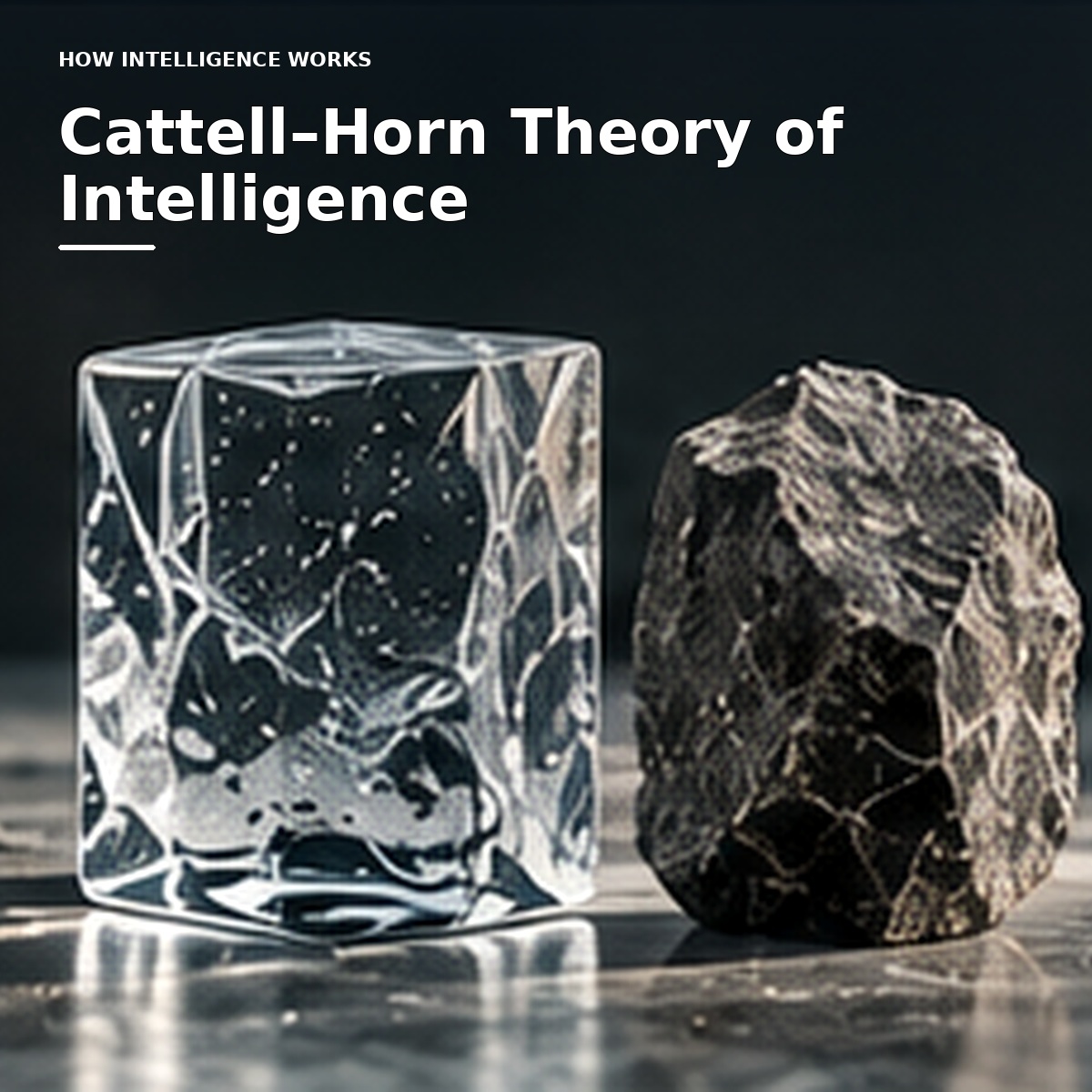
Knowing that intelligence contains broad abilities creates a new question: what kind of abilities are they, and why do they develop differently? One of the most influential answers came from the tradition associated with Raymond Cattell and later John Horn. It distinguished the capacity to reason through relatively novel problems from the knowledge accumulated through education, culture and experience. These became known as fluid intelligence (Gf) and crystallized intelligence (Gc). The distinction is familiar enough to sound merely descriptive. The theory behind it is more ambitious. It asks how reasoning, learning and accumulated knowledge interact across development, and why a person can be strong in one broad form of cognitive performance without being equally strong in another. That makes Gf–Gc more than two definitions. It is part of the field’s attempt to explain how differentiated intelligence develops.
First: an important historical qualification
The conventional label “Cattell’s Gf–Gc theory” hides a more complicated history. Historical scholarship examining correspondence among Raymond Cattell, Donald Hebb, and others has argued that Hebb’s distinction between Intelligence A and Intelligence B substantially influenced the formulation Cattell later called fluid and crystallized intelligence. Cattell introduced the influential fluid and crystallized terminology and developed the psychometric theory; Horn later extended it substantially. For a modern explainer, the safest historical description is therefore:
The Gf–Gc tradition is conventionally associated with Cattell and Horn, while the intellectual history of the distinction includes an important and sometimes under-acknowledged contribution from Donald Hebb.
Reasoning and knowledge can come apart
Imagine two adults. Both are confronted with an unfamiliar logical system they have never studied. Person A infers its rules more quickly. Then both answer questions about a technical vocabulary that Person B has spent twenty years learning. Person B performs much better. One difference concerns reasoning under relative novelty. The other concerns accumulated knowledge. The theory says those differences should not simply be collapsed into one undifferentiated score.
What is fluid intelligence in the theory?
Fluid reasoning concerns the ability to identify relations, infer rules, and solve relatively novel problems when previously acquired knowledge does not directly provide the solution. The word relatively matters. No human cognitive task is literally free of learning, language, strategy, or prior experience. So “fluid” should not be translated as “pure biology” or “culture-free intelligence.” Tests can reduce dependence on specialized knowledge. They cannot create a human mind with no history.
What is crystallized intelligence?
Crystallized intelligence concerns the breadth, depth, and effective use of knowledge acquired through education, culture, language, and experience. Vocabulary is a common indicator because word knowledge accumulates through learning. But Gc is not “how many facts you memorized yesterday.” It represents relatively consolidated knowledge systems that can be recruited in reasoning and communication.
The investment idea: how might Gf and Gc become related?
A major theoretical idea in this tradition is investment. Suppose two children encounter a new scientific concept. A child who more readily detects relations, follows unfamiliar explanations, and solves new problems may acquire some knowledge more efficiently. Across years, that reasoning capacity can be “invested” in learning. But acquired knowledge depends on much more than fluid reasoning:
- exposure;
- schooling;
- reading;
- interests;
- motivation;
- socioeconomic opportunity;
- culture;
- prior knowledge;
- practice.
So the theory is not:
Gc is stored Gf.
A better formulation is:
Fluid reasoning may contribute to knowledge acquisition, while environments and investment choices strongly shape what knowledge actually becomes crystallized.
How investment might unfold over time
Imagine Ana and Bruno begin learning astronomy. At time 1, neither knows much about the field. Ana is somewhat faster at discovering unfamiliar quantitative relations. Bruno reads astronomy constantly and joins an astronomy club. Five years later, Bruno may know far more astronomy despite Ana’s initial reasoning advantage. Now give both a new astronomy problem. Bruno’s accumulated knowledge may allow him to recognize structures that Ana has to derive from scratch. This illustrates why real cognition is recursive:
reasoning can facilitate learning → learning builds knowledge → knowledge changes later reasoning tasks.
The example does not prove the investment theory. It shows the mechanism the theory proposes.
What did Horn change?
Horn did not leave the theory as a two-box division. He expanded the Cattell-Horn framework to include additional broad abilities such as visual processing, memory-related abilities, retrieval, and processing speed. This matters historically because contemporary “CHC” diagrams can create the impression that Cattell, Horn, and Carroll all proposed the same hierarchy. They did not. Horn was notably resistant to placing a single higher-order g at the top of the ability structure in the way Carroll did.
Do Gf and Gc have different age trajectories?
Broadly, yes, but the popular slogan that “fluid intelligence declines while crystallized intelligence rises” is too crude. Different abilities peak at different times. Novel reasoning and speed-related abilities often reach maxima earlier than vocabulary and accumulated knowledge. Knowledge can remain stable or increase for substantial portions of adulthood. But longitudinal changes in fluid and crystallized abilities are also strongly related. Ageing is not two independent curves moving in opposite directions. The theory is useful precisely because it distinguishes abilities while allowing them to remain developmentally connected.
Is the investment mechanism established?
Not in the simple form people sometimes assume. The distinction between fluid reasoning and acquired knowledge is well supported psychometrically. The stronger developmental claim—that fluid ability causally becomes crystallized knowledge through investment—is more difficult to establish. Learning is bidirectional and environmentally structured; prior knowledge affects new learning; interests and personality influence where effort is invested; educational opportunity changes exposure. The investment idea remains theoretically important, but the empirical developmental system is more complex than a one-way Gf → Gc pipeline.
What survives from the Gf–Gc tradition
The Gf–Gc tradition is not merely a vocabulary distinction between “problem solving” and “knowledge.” It is a theory about differentiated cognitive abilities and their development. Its strongest legacy is the recognition that novel reasoning and acquired knowledge are distinguishable but correlated. Stronger claims about exactly how one produces the other require more caution.
References
- Cattell, R. B. (1943). The measurement of adult intelligence. Psychological Bulletin, 40, 153–193. DOI
- Cattell, R. B. (1963). Theory of fluid and crystallized intelligence: A critical experiment. Journal of Educational Psychology, 54, 1–22. DOI
- Horn, J. L., & Cattell, R. B. (1966). Refinement and test of the theory of fluid and crystallized general intelligences. Journal of Educational Psychology, 57, 253–270. DOI
- Brown, R. E. (2016). Hebb and Cattell: The genesis of the theory of fluid and crystallized intelligence. Frontiers in Human Neuroscience, 10, 606. DOI
- McGrew, K. S. (2009). CHC theory and the human cognitive abilities project. Intelligence, 37, 1–10. DOI
- Hartshorne, J. K., & Germine, L. T. (2015). When does cognitive functioning peak? Psychological Science, 26, 433–443. DOI
- Tucker-Drob, E. M., et al. (2022). A strong dependency between changes in fluid and crystallized abilities in human cognitive aging. Science Advances, 8. —. DOI