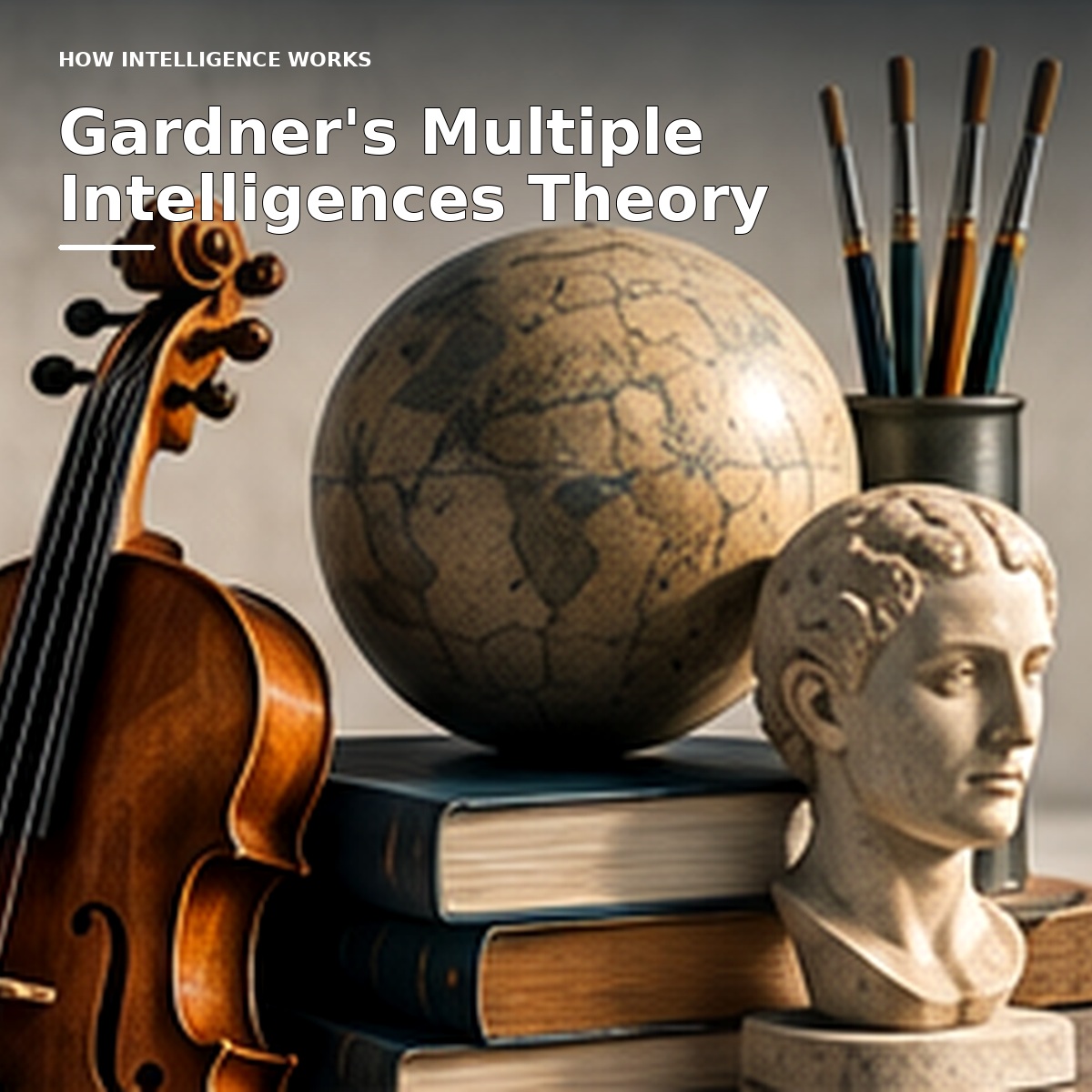
Few theories of intelligence have travelled as far beyond psychology as Howard Gardner’s Multiple Intelligences Theory. The idea appears in schools, teacher training, management writing and popular discussions of human potential. Its appeal is immediate: a brilliant musician, gifted athlete and exceptional mathematician can be impressive in profoundly different ways, so why should intelligence be represented by one narrow kind of test? That question is worth asking. But it contains two different claims. Human beings unquestionably possess many different abilities, talents and forms of expertise. Modern psychometrics also recognizes multiple distinguishable cognitive abilities. Gardner’s theory makes the stronger proposal that capacities such as linguistic, logical-mathematical, spatial, musical, bodily-kinesthetic and interpersonal functioning should be understood as relatively autonomous intelligences. Whether that stronger claim is supported is an empirical question, not something the diversity of human talent can settle by itself.
What did Gardner actually propose?
Gardner objected to defining intelligence too narrowly around conventional academic and psychometric tasks. In Frames of Mind he proposed multiple relatively autonomous intellectual capacities. His criteria drew from neuropsychology, developmental patterns, exceptional abilities, evolutionary considerations, symbolic systems, and other evidence. This is important because MI was never simply:
“Factor analysis found eight independent intelligence factors.”
It did not.
When does a talent become an intelligence?
Imagine four people:
- an excellent mathematician;
- an accomplished violinist;
- an elite dancer;
- a socially perceptive negotiator.
They plainly have different abilities and expertise. But naming each strength an intelligence creates a scientific obligation. We need to ask:
- Does the proposed intelligence form a coherent measurable construct?
- Do different measures of it agree with one another?
- Is it sufficiently distinct from established cognitive abilities, personality, expertise, motor skill, or knowledge?
- Does it predict relevant outcomes beyond those existing constructs?
- Does the proposed set reproduce across samples and measurement methods?
Without those steps, “intelligence” can become a label for any valued human capacity.
What happens when MI is tested psychometrically?
One influential study selected two measures for each of Gardner’s eight proposed domains in 200 adults. The results did not show eight independent intelligences. Measures of several more conventionally cognitive domains loaded substantially on a general factor, while within-domain evidence beyond g was generally modest. That does not prove every aspect of MI is false. It does challenge the strong interpretation that the proposed intelligences constitute largely independent cognitive systems.
What about brain evidence?
Different cognitive activities obviously recruit partly different neural systems. Language, movement, music, spatial processing, social cognition, and memory are not implemented identically in the brain. But neural differentiation does not by itself prove psychometric independence or establish that each differentiated system should be classified as an intelligence. The brain contains specialized systems for many functions. “Uses a distinguishable neural network” and “is an independent intelligence” are not equivalent claims. Some reviews sympathetic to MI have argued that neuroscience provides coherence for Gardner’s domains. Those claims are part of the literature and should be represented fairly. The stronger psychometric objection remains: neural specialization alone does not establish the measurement structure or independence required by a strong multiple-intelligences interpretation.
Does MI-based teaching improve learning?
This is a separate question from whether the theory of intelligence is correct. A classroom technique inspired by a theory could help even if the theory’s psychological ontology were wrong. Conversely, a true theory would not guarantee that every teaching intervention branded with its name works. A systematic review of MI-inspired educational interventions found substantial methodological weaknesses in the primary studies and concluded that a valid evaluation of effectiveness was not possible from that evidence base; the authors did not recommend MI-inspired interventions for improving academic achievement on the basis of those studies. So:
the psychometric validity of MI and the effectiveness of MI-inspired teaching must be evaluated separately.
Is “learning styles” the same as multiple intelligences?
No. The ideas are often blended in education, but they are different claims. A theory of multiple intelligences concerns the structure of human capacities. A learning-styles matching claim says people learn better when instruction is matched to a preferred style. One does not follow logically from the other.
What did MI get importantly right?
A fair review should not reduce the theory to its weakest popular version. Gardner helped push public discussion beyond the idea that one test score exhausts every valuable human capacity. He emphasized that human competence is diverse, culturally situated, and expressed in domains that conventional cognitive batteries do not attempt to measure. Those are useful observations. The disputed move is calling the proposed domains independent intelligences rather than talents, abilities, competencies, expertise, personality-linked capacities, or combinations of these.
Diversity is real; independence is the harder claim
There are many human abilities. There are also multiple psychometrically distinguishable cognitive abilities. Neither fact, by itself, validates Gardner’s particular theory of multiple intelligences. The strongest empirical picture remains one in which many cognitive abilities are differentiated and correlated, rather than a collection of independent intelligences.
References
- Gardner, H. (1983). Frames of Mind: The Theory of Multiple Intelligences. Basic Books. Source
- Visser, B. A., Ashton, M. C., & Vernon, P. A. (2006). Beyond g: Putting multiple intelligences theory to the test. Intelligence, 34, 487–502. DOI
- Visser, B. A., Ashton, M. C., & Vernon, P. A. (2006). g and the measurement of multiple intelligences: A response to Gardner. Intelligence, 34, 507–510. DOI
- Ferrero, M., Vadillo, M. A., & León, S. P. (2021). A valid evaluation of the theory of multiple intelligences is not yet possible: Problems of methodological quality for intervention studies. Intelligence, 88, 101566. DOI
- Shearer, C. B., & Karanian, J. M. (2017). The neuroscience of intelligence: Empirical support for the theory of multiple intelligences? Trends in Neuroscience and Education, 6, 211–223. DOI
- Carroll, J. B. (1993). Human Cognitive Abilities. Cambridge University Press. DOI