
A person can perform brilliantly on a structured reasoning test and still make disastrous decisions in everyday life. Another may never look exceptional on a conventional cognitive battery yet repeatedly find ingenious ways through unfamiliar practical problems. Robert Sternberg took that gap seriously. His Triarchic Theory of Intelligence, and the later theory of successful intelligence, attempted to connect intelligence not only with analytical problem solving but with novelty, experience, adaptation and action in real environments. The familiar shorthand—analytical, creative and practical intelligence—captures part of that project, though the original theory is more elaborate. The attraction is obvious: intelligence should matter in the world, not only in a testing room. The scientific challenge is determining whether these distinctions identify separate general intelligences, different cognitive demands, forms of expertise, or some combination of them.
What is the triarchic theory?
Robert Sternberg’s original triarchic theory was more complex than the popular three-word summary. It contained three interconnected subtheories concerning:
- components — mental processes involved in intelligent
behavior; - experience — how intelligence operates in novelty and in the
automatization of familiar processing; - context — adaptation to, shaping of, and selection of
environments.
The familiar analytical–creative–practical distinction became especially prominent in later presentations and in the theory of successful intelligence.
What do analytical, creative, and practical mean?
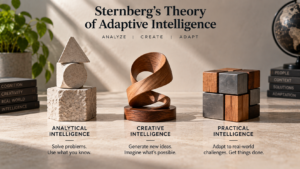
Analytical
Processes used to analyze, compare, evaluate, judge, and solve structured problems.
Creative
The ability to deal effectively with relative novelty and generate useful ideas or solutions.
Practical
The application of knowledge and strategies to real-world situations, including adapting to environments, shaping them, or selecting different environments. In later successful-intelligence formulations, these abilities are coordinated in pursuing personally meaningful goals within a sociocultural context.
Three demands inside one real problem
Imagine a small business is losing customers. An analytical contribution might identify which products, prices, or service failures are associated with customer loss. A creative contribution might generate a new service model competitors have not tried. A practical contribution might recognize that the idea will fail unless employees can implement it, customers understand it, and the owner can negotiate support from suppliers. A successful solution may require all three. But this example shows that three kinds of cognitive demand can be distinguished conceptually. It does not prove that three statistically independent intelligence factors exist. That requires measurement evidence.
How has Sternberg tried to measure the theory?
Research versions of the Sternberg Triarchic Abilities Test (STAT) have included tasks intended to measure analytical, creative, and practical abilities across different content formats. Other work on practical intelligence has used tacit-knowledge measures: scenarios designed to assess practical know-how that is often learned through experience rather than formal instruction. These efforts are scientifically important because the theory has been operationalized rather than remaining purely verbal. But operationalization creates testable questions:
- Do measures within each proposed ability cohere?
- Are the three dimensions separable?
- How strongly do they correlate with g?
- Do they predict outcomes beyond established cognitive measures?
- Do findings replicate across samples and methods?
What has the evidence found?
The literature is mixed and disputed. Sternberg and collaborators have reported factor-analytic and predictive evidence supporting successful-intelligence constructs and have argued that broader assessments capture useful variance not represented by conventional tests. Critics have challenged the independence, measurement reliability, statistical analyses, and incremental validity of practical and triarchic abilities. For example, independent analyses of STAT data have found substantial relationships with general intelligence, and one later analysis of the STAT Level-H concluded that a g model provided the best account of its individual differences. That does not imply creativity or practical know-how are unreal. It means the stronger claim that they constitute broad intelligences independent of g is not securely established.
Practical intelligence or expertise?
This is one of the hardest boundary questions. Suppose an experienced military leader knows that a technically optimal plan will fail because of how a particular unit actually communicates. Is that a distinct general practical intelligence? Or is it domain-specific tacit knowledge accumulated through experience? Practical-intelligence research often uses tacit knowledge precisely because real expertise includes knowledge that is difficult to formalize. But the more domain-specific the knowledge becomes, the harder it is to establish a general intelligence that transfers across contexts. That tension remains scientifically important.
What about creativity?
Creativity is also broader than a single cognitive ability. Creative achievement depends on knowledge, divergent idea generation, evaluation, motivation, personality, opportunity, and domain expertise. So acknowledging creativity as essential to many forms of intelligent accomplishment does not automatically mean “creative intelligence” is a unitary ability parallel to psychometric g. The construct boundary must be demonstrated rather than assumed.
What has Sternberg contributed even if the strong psychometric claim is disputed?
A great deal conceptually. The theory forces intelligence research to confront questions that a test battery alone cannot answer:
- How does a person use ability in a real environment?
- How is novelty handled?
- How does expertise become automatized?
- When should someone adapt to an environment versus change or leave
it? - What counts as successful functioning across different sociocultural
contexts?
These are legitimate questions about intelligent behavior. The controversy concerns how broadly the word intelligence should be extended and whether the proposed abilities have the psychometric independence and generality sometimes claimed for them.
What the theory changes—and what remains disputed
Sternberg’s theory broadens the target from test performance toward intelligent action in context. That theoretical expansion is valuable. The evidence is less decisive for treating analytical, creative, and practical intelligence as three largely independent general abilities. A careful account therefore neither dismisses the theory because g exists nor treats every intuitively useful distinction as a validated intelligence factor.
References
- Sternberg, R. J. (1985). Beyond IQ: A Triarchic Theory of Human
Intelligence. Cambridge University Press. Source - Sternberg, R. J. (2003). Wisdom, Intelligence, and Creativity
Synthesized. Cambridge University Press. DOI - Sternberg, R. J. (2020). The augmented theory of successful
intelligence. In R. J. Sternberg (Ed.), The Cambridge Handbook of
Intelligence (2nd ed., pp. 679–708). Cambridge University Press. DOI - Brody, N. (2003). Construct validation of the Sternberg Triarchic
Abilities Test. Intelligence, 31. DOI - Gottfredson, L. S. (2003). Dissecting practical intelligence theory:
Its claims and evidence. Intelligence, 31, 343–397. DOI - Sternberg, R. J. (2003). Issues in the theory and measurement of
successful intelligence: A reply to Brody. Intelligence, 31,
331–337. DOI - Chooi, W.-T., Long, H. E., & Thompson, L. A. (2014). The
Sternberg Triarchic Abilities Test (Level-H) is a measure of g.
Journal of Intelligence, 2, 56–67. DOI