Sternberg argued that intelligence should be understood partly through how people use analytical, creative and practical abilities to pursue meaningful goals—not only through conventional test performance. A student can be superb at solving well-defined examination problems and repeatedly fail when nobody tells them what the problem is. Another can generate imaginative ideas but struggle to decide which one is workable. A third knows how to navigate messy real-world constraints yet looks ordinary on conventional academic measures. Robert Sternberg’s theory of successful intelligence was built around differences like these. It developed from his earlier triarchic theory and argued that intelligent success involves a balance of analytical, creative and practical abilities, applied toward attaining goals within a person’s sociocultural context.
The theory is broader than the claim that there are simply “three intelligences.” Its emphasis is on how abilities are used.
Analytical, creative and practical are jobs, not three sealed boxes
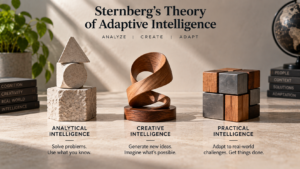
Analytical abilities are involved in evaluating, comparing and reasoning through problems. Creative abilities help deal with novelty, generate ideas and move beyond familiar routines. Practical abilities concern applying knowledge and adapting to real-world demands. Imagine launching a small business. Analytical thinking may be needed to model costs. Creative thinking may help identify an unmet need. Practical intelligence may matter when negotiating with suppliers, reading a customer or adjusting when the original plan meets reality. The same person can use all three. A single task can demand all three. Treating them as independent mental organs would oversimplify Sternberg’s proposal.
Adapt, shape or select
Successful intelligence also emphasizes a person’s relationship with the environment. Sometimes success means adapting oneself to existing conditions. Sometimes it means shaping those conditions. Sometimes the intelligent move is to select a different environment. Consider an employee whose role systematically prevents them from using their strongest skills. They could learn to work within the role, negotiate changes to it, or leave for a better fit. Which response is intelligent depends on goals, constraints and consequences. That contextual element is part of what makes the theory attractive—and part of what makes it harder to measure with the precision of a conventional psychometric model.
What counts as success?
Sternberg explicitly tied successful intelligence to achieving goals that matter within a sociocultural context. That avoids defining success solely as a high test score. But it raises a problem: goals can conflict, cultures value different outcomes, and people can be extremely effective at achieving destructive ends. Later developments in Sternberg’s thinking increasingly brought wisdom, ethics and collective consequences into the picture. A theory of successful intelligence therefore cannot avoid normative questions simply by using the word “success.”
Can the three abilities be measured separately?
Sternberg and colleagues developed assessments intended to sample analytical, creative and practical skills and reported studies in educational settings in which broader assessments predicted outcomes and revealed different performance profiles. Instruction designed to engage multiple forms of ability has also been studied. However, the psychometric independence and incremental validity of practical and creative intelligence have been disputed. Critics have argued that some evidence for a general practical-intelligence factor distinct from g is weaker than claimed, and that broader measures can still contain substantial general cognitive variance. This is an important inferential boundary. Evidence that a practical task predicts performance does not by itself prove a separate practical intelligence. The prediction could arise from general ability, knowledge, personality, situational judgment or a combination.
Is successful intelligence an alternative to g?
Not in the simple sense of one model making the other disappear. g describes a robust general dimension in cognitive-test covariance and predicts many outcomes. Successful intelligence makes a different theoretical claim: conventional psychometric ability may not exhaust what matters when people pursue goals in varied real environments. Those propositions can both contain truth. The scientific question is how much additional explanatory and predictive value the broader constructs provide, how reliably they can be measured and whether they are genuinely distinct from existing constructs.
What the theory changed
Successful intelligence pushed intelligence research toward a question conventional testing can leave in the background: what happens when the problem is not already defined, the goal is contextual and the environment can be changed? That is a serious question. The evidence is less decisive than the breadth of the theory sometimes suggests, particularly for claims that analytical, creative and practical abilities form cleanly distinct psychometric capacities. The fairest reading is therefore neither that successful intelligence displaced traditional intelligence nor that it added nothing. It broadened the target of explanation—from solving decontextualized problems to using cognitive resources in pursuit of goals—and forced researchers to ask which parts of that broader target can be measured as rigorously as the abilities it was designed to supplement.
References
- Sternberg, R. J. (1999). The theory of successful intelligence. Review of General Psychology, 3, 292–316. DOI
- Sternberg, R. J. (1999). Successful intelligence: Finding a balance. Trends in Cognitive Sciences, 3, 436–442. DOI
- Sternberg, R. J., et al. (2006). Using the theory of successful intelligence as a basis for augmenting AP exams in Psychology and Statistics. Contemporary Educational Psychology, 31, 344–376. DOI
- Gottfredson, L. S. (2003). Dissecting practical intelligence theory: Its claims and evidence. Intelligence, 31, 343–397. DOI