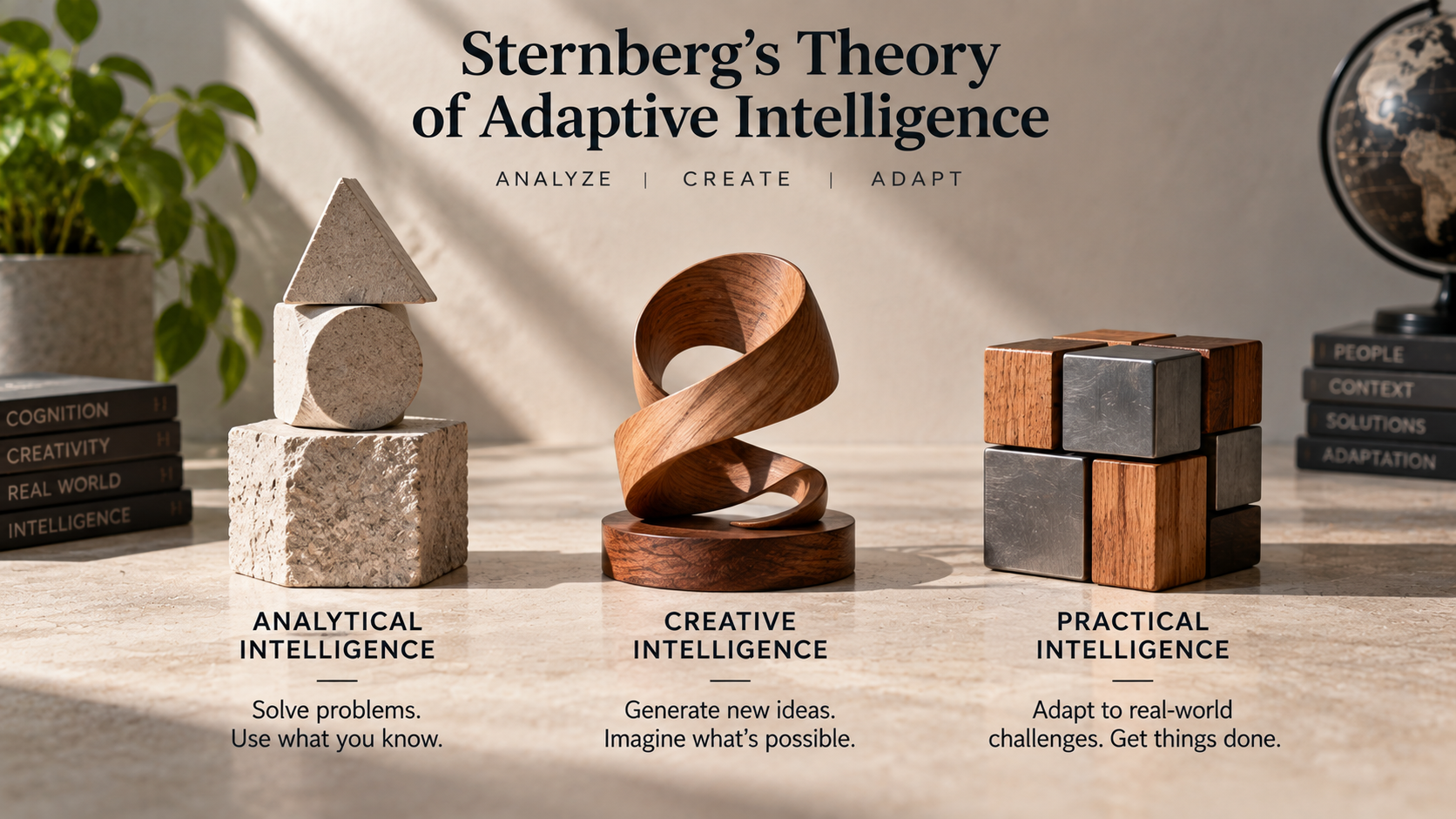
Adaptive intelligence asks whether being good at cognitive tests is enough if a person’s thinking fails to help people adapt to the real problems their environments create. A society can become extraordinarily good at extracting fossil fuels, optimizing advertising or designing financial instruments and still create conditions that threaten its own long-term welfare. If intelligence is usually defined partly as the capacity to adapt, Robert Sternberg asks, adapt to what—and for whose survival or flourishing? His theory of adaptive intelligence is a recent extension of a long-running argument that intelligence cannot be understood entirely as a stable score residing inside a person. Intelligent behaviour emerges from an interaction among a person, a task and a situation, and adaptation has to be evaluated in real environmental and cultural contexts. This is a theoretical proposal, not an established replacement for psychometric intelligence.
The problem with treating intelligence as context-free
Suppose Elena is an excellent abstract reasoner. In one workplace, her ability to challenge assumptions is rewarded. In another, information is tightly controlled and dissent is punished. The same person may display very different levels of effective problem solving because the task and situation alter what can be perceived, attempted and rewarded. That does not mean her cognitive abilities vanish when the context changes. It means observed intelligent behaviour is produced by more than the trait alone. Sternberg’s person × task × situation formulation makes this interaction explicit. A conventional test deliberately standardizes the situation so people can be compared under similar conditions. That is a strength for measurement. It can also limit what the result tells us about performance across radically different real-world situations.
Adaptation is not passive conformity
In Sternberg’s broader framework, adapting intelligently does not mean simply fitting into whatever environment exists. People can adapt themselves, shape environments or select different ones. A harmful institution may reward conformity. Calling the best conformist the most adaptively intelligent would make adaptation too narrow. Sternberg therefore connects adaptive intelligence to longer-term consequences and, increasingly, to collective as well as individual welfare. This is where the theory becomes explicitly normative. Whether an outcome promotes a “common good” cannot be derived from a correlation matrix alone.
Why climate change is an intelligence problem in this theory
Sternberg uses civilization-scale failures to expose the gap he sees between cognitive sophistication and adaptive success. Humans can possess extraordinary scientific and technical capacities while using them in ways that damage the conditions on which future flourishing depends. The point is not that IQ causes climate change or that environmental concern is an intelligence test. It is that a species can be instrumentally clever without behaving adaptively in the long run. Adaptive intelligence therefore asks whether our concept of intelligence should include the quality of adaptation itself.
How is adaptive intelligence measured?
This is one of the theory’s hardest problems. Standardized intelligence tests benefit from carefully controlled tasks and norm groups. Situation-sensitive assessment would need to sample enough tasks and contexts to support general conclusions about a person. If someone performs wisely in one conflict and poorly in another, is that a stable ability difference, a situational effect or both? Without broad and reliable sampling, the theory risks explaining outcomes after the fact: behaviour that worked gets called adaptive. Sternberg himself has emphasized the difficulty of situation-based testing and argues for more modest interpretations of conventional assessments. That acknowledgement is important. At present, adaptive intelligence is more developed as a theoretical critique and research programme than as a mature psychometric construct with the evidential infrastructure of g or CHC abilities.
How does this differ from successful intelligence?
Successful intelligence emphasized using analytical, creative and practical abilities to achieve goals through adapting to, shaping or selecting environments. Adaptive intelligence pushes the argument further toward the consequences of adaptation, including effects on other people, future generations and the environment. The shift responds to an obvious problem: successfully achieving a personal goal is not necessarily intelligent in any broader adaptive sense if the goal is destructive.
Does context make general intelligence irrelevant?
No. Stable cognitive differences can remain predictive even when performance is context-sensitive. Person × situation interaction does not logically erase person-level traits. The empirical challenge is to determine when context changes rank order, when general abilities transfer across situations and whether measures of adaptive intelligence predict important outcomes beyond established cognitive and noncognitive constructs.
A theory asking intelligence to justify its consequences
Adaptive intelligence is provocative because it changes the criterion. Instead of asking only whether a person can solve difficult problems, it asks whether their thinking helps create viable adaptation in the environments humans actually inhabit. That broader criterion may prove too value-laden or difficult to measure as a single intelligence construct. It may instead belong partly to wisdom, judgment, ethics and collective decision-making. But the challenge is substantive: cognitive power and adaptive use of cognitive power are not the same thing. A complete science of intelligent behaviour may eventually need to explain both.
References
- Sternberg, R. J. (2019). A theory of adaptive intelligence and its relation to general intelligence. Journal of Intelligence, 7, 23. DOI
- Sternberg, R. J. (2021). Adaptive intelligence: Intelligence is not a personal trait but rather a person × task × situation interaction. Journal of Intelligence, 9, 58. DOI
- Sternberg, R. J. (2021). Adaptive intelligence: Its nature and implications for education. Education Sciences, 11, 823. DOI
- Sternberg, R. J. (1999). The theory of successful intelligence. Review of General Psychology, 3, 292–316. DOI